I had an amazing time attending the International Reading Association convention in Chicago this year! The theme was Celebrating Teachers... I left the conference motivated, excited and ready to share all the great learning experiences I had. (Unfortunately, I have not shared with anyone yet...no time!) The atmosphere and the teaching professionals that came from all over the world were motivating beyond anything I had experienced.
I arrived on Sunday to attend an Institute: Developing Literacy Leadership: Key to School Improvement. It was an all day workshop and the speakers were educators I have followed and read much of their research work or published articles. Monday's workshop was Using RTI to Promote Whole-School Change in Literacy that followed the theme from Sunday. Both sessions were filled with information, research and handouts that I could bring back and use with my work at H-D. Each day I was nodding saying "yes! we are doing that" and "yes! we will get there". Mr. Speake traveled with me and he was so good to listen to my endless jabbering after each day. My only disappointment was that all of the H-D elementary teachers couldn't be there.
Workshop Presenters: Rita Bean, Susan L'Allier & Laurie Elish-Piper, Michael McKenna, Mary Ellen Vogt and Sharon Walpole, Judy Wallis, Nancy Allison, Nancy McLean, & Joan Jennings among several others.
Other famous people I heard:
Timothy Rasinski, Frank Serafini, the infamous duo of Fountas & Pinnel throughout mini-sessions in the exhibition hall. I stood by Richard Allington in the Starbucks line....I was so star struck and of course I couldn't think of anything intelligent to say!
The authors I saw:
Jerry Pallotta, Mem Fox, Kate Messner, Annie Borrows, Nicholas Sparks (well his brother but it was amazing to visit with him about his brother's books which my daughters love to read!) The moments were priceless. Well, if you live in the educational world of literacy!
The overall lesson I learned....
Motivating readers and making students life-long readers must be our ultimate goal using a reader's workshop model (gradual release) and explicitly teaching skills in all five literacy areas. WOO HOO!! Independent reading is the most powerful tool a teacher can implement in their classroom. This was just the encouragement and motivation I needed as I try to continue to help our teachers at H-D transform their classrooms to workshop model with an emphasis on independent reading.
Reading is the cornerstone of student success in school. Many of our students today do not receive any reading support at home for a wide-variety of reasons. It must be our job to share our passion and love for reading which will be a life skill that will help students in all they do.
Happy Reading! Mrs. Speake
Showing posts with label readers workshop. Show all posts
Showing posts with label readers workshop. Show all posts
06 May 2012


05 February 2012
Making Meaning & Vocabulary
What a great week! The elementary teachers just completed team work days for literacy. The literacy committee put together core beliefs for a comprehensive literacy program for our school district-LOTS OF WORK, RESEARCH & DISCUSSION. The committee defined core beliefs in the five big areas of literacy as defined by the National Reading Panel. (Phonemic Awareness & Phonics, Fluency & Accuracy, Comprehension, Vocabulary and Writing)
What brought on this journey? The teachers in our district have been using a Basal program for the last ten years. With our student demographics changing over these ten years, teachers were led to the belief that....... IT'S NOT WORKING!!! We won't mention the watch list we were on or the S.I.N.A. title we received at the middle school.
This year we decided to begin the literacy transformation with these goals in mind.......
*Bring back the love of reading through independent reading and encourage life-long learning
*Classroom libraries organized and emphasized to encourage "just right" book reading at every grade level
*Explicitly teach the seven comprehension strategies in grades 1-5, (Kindergarten- modeling) across all curriculum areas
*Writing daily through our writer's workshop (Lucy Calkins Primary Units of Study)
Teachers have spent hours writing plans, finding quality read alouds & setting up a workshop model!! We know beyond a doubt children need to be reading daily at their "just right" level and EVERY year the students need explicit instruction on each comprehension strategy. EVERY grade level must be unified and the gaps between grade levels MUST be connected. With the Basal curriculum not working, teachers had to search and find materials they felt were best..... which created a chain of islands! ( YES, teachers have been feeling like they were on an island- alone and stressed with no rescue boat in sight.) With this and our core beliefs in mind, the literacy committee looked into many curriculum ideas for purchase which led us to a program we wanted to pilot in January. After piloting a conclusion was made.
(drum roll, please!) MAKING MEANING with Vocabulary will be purchased and delivered to every classroom teacher by March/April 2011. This is a comprehension program with vocabulary that relies on the gradual release model as teachers explicitly teach comprehension strategies, incorporate daily independent reading activities and teach vocabulary using Isabel Beck's research model. The second unique goal of this program is to provide opportunities for students to work together and to develop socially and ethically. This community building component is really what excites me the most as I have watched our committee members pilot this program in their classrooms. The majority of our children need help in learning how to think and socialize in a positive manner with positive role models. (the links are in blue)
Check out the programs! I LOVE that it is a non-profit, research based company, designed and operated by REAL teachers that BELIEVE in our education system. Also check out the Caring School Community Program that we could also adopt. Email your principal or guidance counselor if you think the Caring Community Program looks like something H-D might consider to build positive student behaviors school wide.
We still have so much work to do but for now after THE BIG REVEAL, I actually slept! My biggest hope for the FABULOUS teachers I work with, is that they feel less stress and a renewed sense of excitement in their teaching.
Happy Reading- Mrs. Speake
01 January 2012
Happy New Year!!
I hope everyone had a blessed Christmas and had time to relax and enjoy family. I love having my two older children home from college. We were all ready for slow moving days. Staying in my P.J.s until noon, drinking coffee and reading......can’t get much better than that!
It's hard to believe its a new year already. I decided to take time to challenge myself professionally. I have made a list of books I want to read. As I began my masters program a few years ago I realized how lazy I had gotten staying in tuned to professional readings and current research. I get excited to read new professional books and to learn new strategies. With my new role in literacy its nice to be able to focus on one area. As a teacher, each year you will have different learners and you must have many strategies that work to help all of your students be successful. Your PD time will NOT be sufficient or personalized. YOU must be in control of your continued learning and striving to be successful.
What are you reading as a teacher? What do you want to learn about? I challenge you to re-think reading professionally. Look at it as motivation and excitement that you can find new things to enhance your teaching. Feel good about taking time to learn! SO join me in the reading challenge. . . . .
My Reading List: (click on the title to find out more)
Conferring: The Keystone of Reader’s Workshop (taking time to talk to readers 1:1 is so important and it can be done, hoping to learn how to do this better)
Read It Again! Revisiting Shared Reading ( I am currently in the middle of this-quick read & great reminder to create a love of reading with our young learners!)
Developing Essential Literacy Skills: A Continuum of Lessons for Grades K-3 (this talks a lot about creating a balanced literacy approach and closing the gap grade to grade-exactly what we are trying to do at H-D)
Notebook Connections: Strategies for the Reader's Notebook (hope to get insights how to help older readers be accountable for their reading...fits great with our workshop goals and conferring with readers)
Notebook Know-How: Strategies for the Writer's Notebook (fits in well with our writer's workshop model but I keep hearing how hard it is for our older students-how do we get them to write more? write freely? )
The Failure Free Reading Methodology: New Hope for Non-Readers (I received this on my Kindle from a friend, wondering if he has ideas for our many older non-readers!!)
I also love having my Kindle! I can download samples of the above, read the first few chapters and then decide....
I love AMAZON...... buy the books used or become an Amazon Prime member!
Happy Reading! Mrs. Speake
P.S. We are actually in school tomorrow!! What happened to our holiday observation of the 1st??? Bummer! :)
23 October 2011
Schema
Schema is the next comprehension strategy our elementary students are learning. Most readers and teachers know schema as "background knowledge". Schema is everything in our brains that we have experienced. All the things I've done, all the places I've been and all the books I've read. Good readers always use their schema before reading, during reading and after reading.
At South Side we want our readers to know how to use their schema and how to make meaningful connections. Connections may be text-to-self, text-to-text and text-to-world. With a read aloud, teachers will model how to use schema and make meaningful connections while reading. Next readers will work with their teacher to make connections and finally they will practice making connections during their independent reading time with their "just right" books.
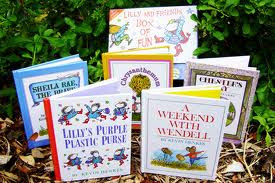 Some of my favorite text to use for modeling connections are from the author Kevin Henkes. His stories have characters that children relate to easily and the text is full of rich and engaging vocabulary. To share a few of his characters..... Chrysanthemum is teased about her long flower name, Lilly is quite a unique individual and takes her purse to school and learns a valuable lesson when she gets in trouble, Wendell is a wild child that "wears" most of his friends out and Chester is best friends with Wilson. They are "two peas in a pod" doing everything together until Lily moves into the neighborhood.
These books can be read over and over pulling many valuable lessons, rich vocabulary and meaningful connections that help our readers become successful with using comprehension strategies independently.
Reading should always be meaningful and engaging. Our elementary students (1-5 grades) will hopefully tell you, "making connections and using our schema helps us to better understand the story" !
Happy Reading- Mrs. Speake
At South Side we want our readers to know how to use their schema and how to make meaningful connections. Connections may be text-to-self, text-to-text and text-to-world. With a read aloud, teachers will model how to use schema and make meaningful connections while reading. Next readers will work with their teacher to make connections and finally they will practice making connections during their independent reading time with their "just right" books.

These books can be read over and over pulling many valuable lessons, rich vocabulary and meaningful connections that help our readers become successful with using comprehension strategies independently.
Reading should always be meaningful and engaging. Our elementary students (1-5 grades) will hopefully tell you, "making connections and using our schema helps us to better understand the story" !
Happy Reading- Mrs. Speake
12 October 2011
Did you say METACOGNITION??
 Yesterday a parent stopped by to share some good news! Her son came home sharing the new word he learned in Kindergarten - "me ta cog ni tion"! Of course the parents said - what does this mean?? He slowly said - "thinking about your thinking!" Woo hoo!
The elementary students are learning reading comprehension strategies for their developmental level. Metacognition is the latest buzz word in psychology. Metacognition enables us to be successful learners, and has been associated with intelligence (e.g., Borkowski, Carr, & Pressley, 1987; Sternberg, 1984, 1986a, 1986b). Metacognition refers to higher order thinking which involves active control over the cognitive (thinking) processes engaged in learning.
We are teaching the process of good thinking strategies for reading. Kids know that good readers think about what they are reading. If we don't engage our brain when we read it is "fake" reading and only "real" reading helps our brain grow! The thinking strategies we are teaching can carry over to math, science, social studies and writing. We must engage our brains with everything we do. Plus young kids love to say big, juicy words. Its the hook that makes the learning stick.
Tanny McGregor wrote a wonderful book, Comprehension Connections. We are implementing many of her ideas K-5. Many of the teachers at South Side will readily share - we are learning right along with the kids and it's exciting. Raising our expectations and raising our students to be life-long learners.
Is there anything better than picking up a good book and reading?
Happy Reading! Mrs. Speake
12 September 2011
Stamina
endurance, staying power, tirelessness, fortitude, strength, energy, toughness, determination, tenacity, perseverance, grit.
Stamina is a vocabulary word the elementary students are using when they are reading. The dictionary defines stamina as the ability to sustain prolonged physical or mental effort. The K-5 teachers are dedicating a portion of each day encouraging independent reading time which requires the students to build .....stamina.
Students need daily practice to build reading muscles. Just as athletes need to build their muscles for running or swimming, students need to build their learning muscles. Reading stamina does not come natural to most children. Teachers model procedures and routines to establish an environment that encourages on-task reading behaviors. This takes teacher reading and planning time and daily student practice time. It also takes oodles and oodles of quality books for the student's reading time.
The Sisters, Steven Layne, Kelly Gallagher and Donalyn Miller are a few of the published authors you can find our teachers reading in their free time which means late at night or on weekends! :) Teachers must be life-long learners to enhance their own teaching strategies. Together we are improving and sharing new ideas to build student’s reading stamina and to help students become life-long readers and learners.
Its a privilege to be part of a teaching community willing to work hard and learn together!
Happy Learning-Ronna
Subscribe to:
Posts (Atom)